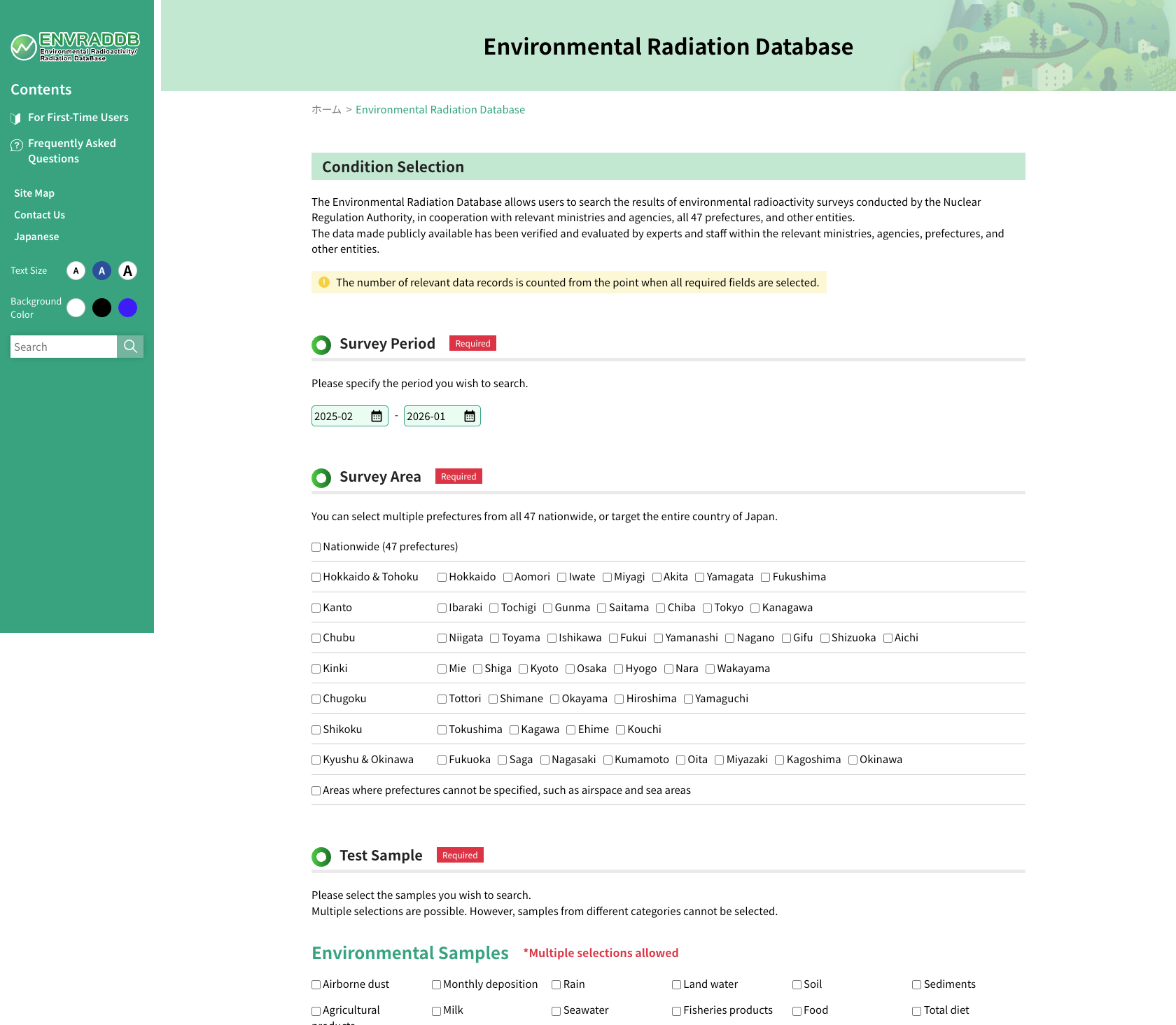


The Environmental Radiation Database allows users to search results from environmental radioactivity surveys conducted by the Nuclear Regulation Authority in cooperation with relevant ministries and all 47 prefectures. It is a valuable resource for accessing radiation-related data. Here are some examples of utilization.
1.
Investigate local radiation levels
You can determine radiation levels in your local area or travel destination.
2.
Assess environmental impacts
You can track changes in radiation levels in various environmental media, such as soil and water, following a nuclear accident.
3.
Educational purposes
It can be used for independent research projects at school and to enhance understanding of radiation science.
Example scenario
To investigate the changes in soil radioactivity in a specific area following the 2011 Fukushima Daiichi Nuclear Power Plant accident:
1. Specify the survey period , starting from 2011 and spanning several years.
2. Select the relevant location within the surveyed region.
3. Choose "soil" as the survey medium.
4. Specify Cs-137 or other relevant radionuclides as the survey nuclides for the search.
The search results can be exported as a CSV file, enabling users to generate graphs and visualize the data.
Visualizing the data through graphs facilitates a clearer understanding of the changes over time.
The data in the Environmental Radiation Database is collected by public organizations and rigorously reviewed and evaluated by experts before release. The database is regularly updated with new survey results, providing access to the most current information.
This rigorous process ensures the database's high reliability and provides users with the most up-to-date environmental radiation data.