


Overview
What is 14C?*1, *2, *3
Carbon-14 (14C) is a radioactive isotope of carbon and a "pure β- emitting
nuclide," meaning it emits β rays
due to β decay but does not emit γ rays. It has a half-life of 5,700 years.
The primary sources of 14C are:
1. Interactions between cosmic rays and nitrogen atoms,
2. Atmospheric nuclear tests,
3. Activation reactions involving nitrogen, etc., in nuclear reactors.
Regarding source 3, 14C is released during the reprocessing of spent nuclear fuel. Cosmic rays
produce
approximately 1.4 PBq (PETA = 1015) of 14C annually, and the global inventory of
14C is estimated to be
around 8,500 PBq. The majority resides in the oceans, with approximately 140 PBq present in the
atmosphere.
During the 1950s and 1960s, frequent atmospheric nuclear tests released about 350 PBq of 14C
into the
atmosphere. This significant supply caused a rapid increase in the specific radioactivity of
14C in
atmospheric carbon dioxide, peaking at 1.5 to 2 times the pre-nuclear testing levels by the mid-1960s.
Since then, the cessation of atmospheric nuclear tests and the release of "dead carbon" (carbon devoid of
14C) from fossil fuel combustion (the Suess effect) have led to a decline in the specific
radioactivity of
14C in the atmosphere. In comparison, global emissions of 14C from reprocessing
plants are estimated to be
about 2 PBq, which is negligible relative to the releases from atmospheric nuclear tests.
14C Analysis objective*4, *5
14C is measured to estimate and evaluate radiation doses received by residents living near reprocessing facilities during routine monitoring. 14C is widely utilized across various research fields. In environmental research, it serves as a natural tracer to identify the sources and understand the dynamics of various substances of both natural and human sources. In the field of archaeology, carbon dioxide is used for dating because plants and animals absorb carbon dioxide during photosynthesis and the food chain, and its levels decrease after their death.
Main methods of analysis for 14C
Benzene synthesis method
The benzene synthesis method involves pretreatment with a vacuum line,
followed by measurement with a liquid scintillation counter. This method enables high-accuracy analysis
and is suitable for environmental radiation monitoring.
Detectable level: 0.002 Bq/gC (1.7 g of carbon, counting efficiency 75 %, BG count rate 0.3 cpm,
measurement time 500 min).
Carbon dioxide absorption method
The carbon dioxide absorption method involves pretreatment with commercially available instruments and
measurement with a liquid scintillation counter. It offers a simple analysis method (including
screening) for environmental radiation monitoring.
Detectable level: 0.02 Bq/gC (1.0 g of carbon, counting efficiency 55 %, BG count rate 11 cpm, and a
measurement time of 500 minutes).
Accelerator mass spectrometry (AMS)
Accelerator Mass Spectrometry (AMS) is primarily employed by research
institutions for the analysis of environmental samples for research purposes.
This method involves preparing measurement samples through chemical treatment tailored to the sample,
followed by the use of an accelerator to measure the target mass number. At present, it provides the
highest sensitivity for the quantification of carbon-14 (C-14). However, because the measurement system
is extremely large and expensive, its general use has not become widespread, and the number of
analytical institutions capable of performing such measurements remains limited. Despite these
limitations, C-14 analysis using AMS is applied in a wide range of fields beyond environmental
monitoring, including age determination and other research applications.
Detectable level: 0.0002 Bq/gC (converted from 14C/12C =
1.0x10⁻¹⁵; measurement sample amount is about 1 mg).
Analytical flow (benzene synthesis method)
Organism sample
Freeze dryer
Dry matter
High-speed combustion chamber
Carbon dioxide( C + O2 → CO2 )
Benzene synthesizer
Lithium carbide( 10Li + 2CO2 → Li2C2 + 4Li2O )

Acetylene( Li2C2 + 2H2O → C2H2↑ + 2LiOH )
Benzene( 3C2H2 → C6H6 )
Sample preparation
Benzene + scintillator
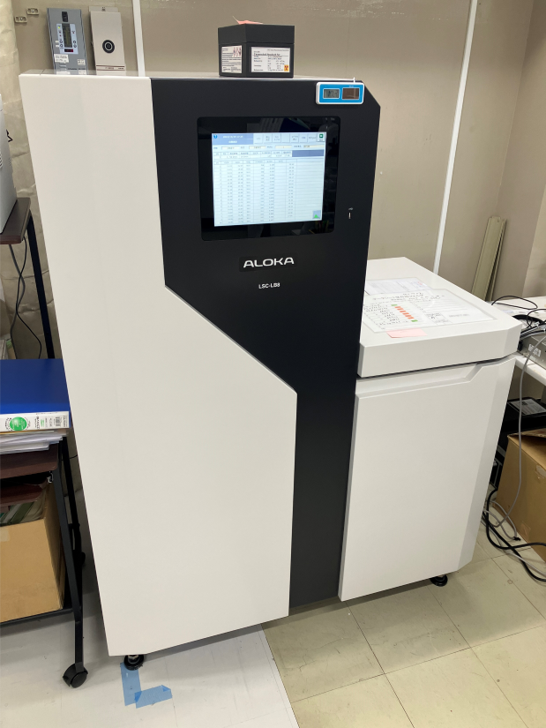
LSC
Measurement
Topics
Topics1
Which method of 14C analysis would you choose?
There are three primary methods for 14C analysis. Which method is best suited for your needs? If you require the highest possible precision, for example, for research purposes, accelerator mass spectrometry is the optimal choice. Currently, no other method offers higher precision than accelerator mass spectrometry. However, installing an accelerator typically demands a significant amount of space, equivalent to a gymnasium, making it impractical for most individuals to own one. Consequently, measurements must usually be outsourced to organizations equipped with accelerators. Finding a suitable outsourcing partner can be time-consuming. If you do not need such high precision and are primarily interested in monitoring, etc., either the benzene synthesis or carbon dioxide absorption method is suitable. Between the two, benzene synthesis generally provides more accurate results. However, benzene synthesis requires a vacuum line for sample preparation, while carbon dioxide absorption can be prepared using commercially available glassware. Both methods necessitate a liquid scintillation counter for measurement. Considering these factors, which method would you select?
Topics2
Are gases dangerous?
The benzene synthesis method involves manipulating a complex glass vacuum system. The pretreatment process handles gases like carbon dioxide and acetylene, which are colorless and odorless. Unlike liquid-based pretreatments conducted in beakers, these gases are invisible, making valve operations and pressure gauge readings crucial. Accidental pressurization can lead to the rupture of glass tubes. Therefore, it is imperative to wear appropriate protective gear and exercise extreme caution during analysis.
Related radioactivity measurement series

References
-
*1
Tetsuo Iwakura. 14C from Nuclear Facilities. Journal of the Atomic Energy Society of Japan. 1993. vol. 35, no. 10, p. 874.
-
*2
UNSCEAR. UNSCEAR 2008 Report. 2010. vol. Ⅰ.
-
*3
P.P. Povinec. et al. Impact of the Fukushima accident on tritium, radiocarbon and radiocesium levels in seawater of the western North Pacific Ocean: A comparison with pre-Fukushima situation. Journal of Environmental Radioactivity. 2017. vol 166, p. 56-66.
-
*4
Radiation Monitoring Division, Nuclear Regulation Authority. Routine Monitoring. Supplementary Material of the Guidelines for Nuclear Emergency Preparedness. Revised on December 21, 2021.
-
*5
Miyuki Kondo. Use of Radiocarbon (14C) as a Natural Tracer in Environmental Studies. NIES News. 2015. vol. 33, no. 6.