


Overview
What is tritium?*1, *2
Tritium is a radioactive isotope of hydrogen that emits β rays through beta decay but does not emit γ rays, making it a “pure β emitter.” Its half-life is 12.32 years.
| Symbol | Mass number | Property | Natural abundance | |
| Protium | 1H | 1.0078 | Stability | 99.9885% |
| Deuterium | 2H,D | 2.0141 | Stability | 0.0115% |
| Tritium | 3H,T | 3.0160 | Radioactivity | Trace amount |
Source of tritium*3, *4
[Natural source]
・Tritium is produced by nuclear reactions (14N+n→
3H+12C, etc.) in the upper atmosphere between nitrogen or oxygen and secondary
cosmic rays originating from primary cosmic rays.
(Some are produced by spontaneous nuclear fission
of uranium, etc., in the earth's crust. However, the amount is negligible compared to the amount
produced in the atmosphere.)
[Artificial origin]
・Release into the environment by past atmospheric nuclear tests (ternary fission of 235U, 238Pu, etc., and reaction of the produced neutrons with N or O)
・Release into the environment from nuclear facilities (nuclear power plants and reprocessing plants) (ternary nuclear fission of the nuclear fuel and nuclear reaction of 10B in the control rods (moderators), and activation of reactor water)
Existence form of tritium*3 - *5
The annual tritium production in the atmosphere is estimated to be 72 PBq (P (PETA) = 1015), most of which is oxidized to tritiated water (HTO: one hydrogen atom replaced by tritium (T)), absorbed into the water cycle, including atmospheric moisture, rainwater, land water, and seawater.
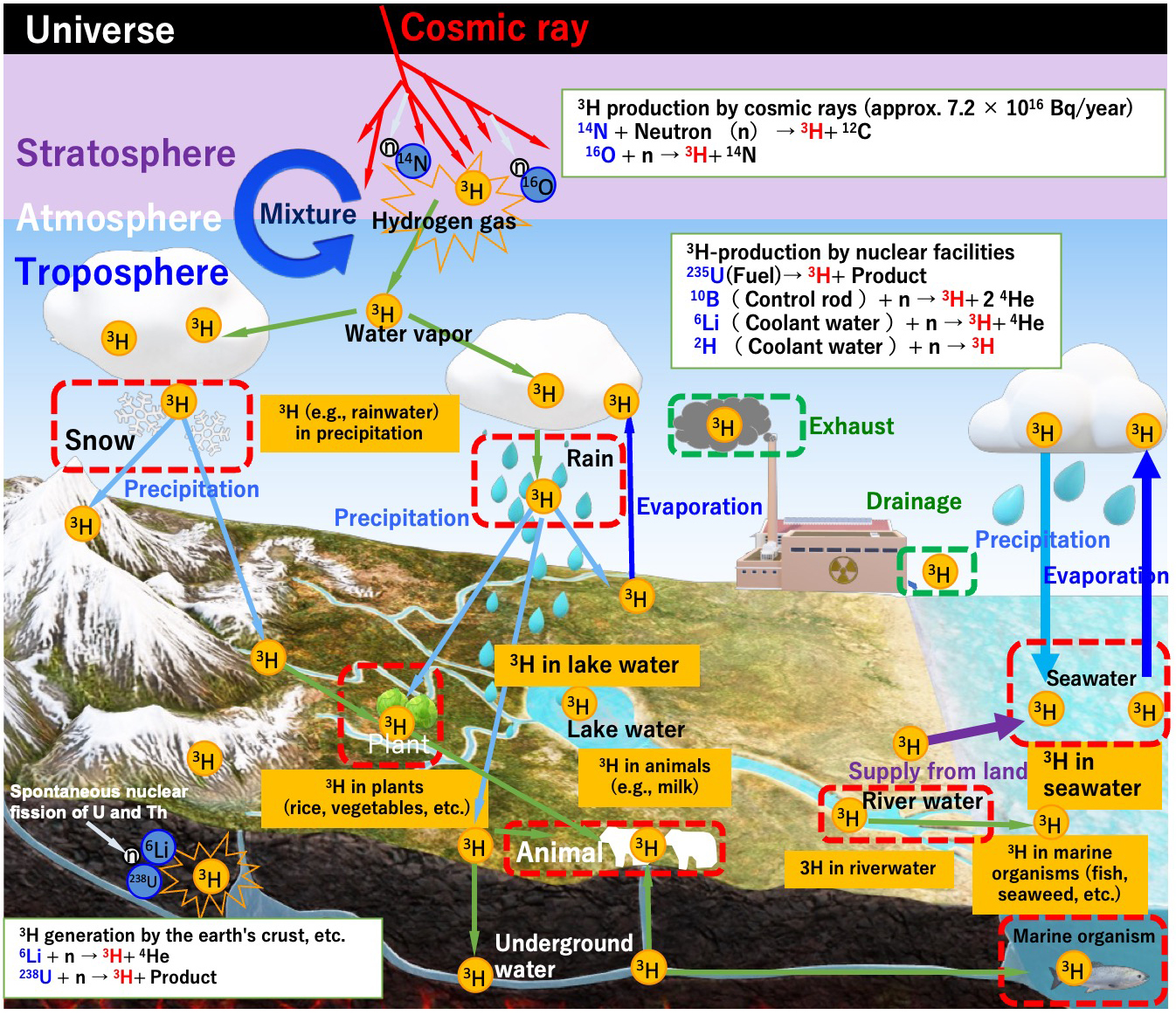
In addition to tritiated water, other chemical forms of tritium include gaseous tritium (HT, CH3T), tissue-free water tritium (TFWT) found in organism samples where tritium has been incorporated, and organically bound tritium (OBT). Organically bound tritium can be classified into two types: exchangeable type, in which tritium is easily exchanged with hydrogen by binding to oxygen or nitrogen molecules, and non-exchangeable type, in which tritium is bound to carbon chains and is not easily exchanged.
Objectives of Tritium Analysis*6-*8
Tritium is a radioactive isotope of hydrogen, one of the principal elements constituting the human body. Therefore, the chemical form of tritium at the time of intake—since it determines metabolic behavior—is important for dose assessment.
When tritium enters the body through one of the three pathways—respiration (inhalation), skin (absorption), or ingestion (food and drink)—the chemical forms to be considered differ: moisture in the air and hydrogen gas for respiratory and dermal routes, and water and organically bound tritium for food and drink. In addition, understanding the behavior of tritium within the environmental ecosystem—including agricultural, livestock, and marine products—is also necessary.
To treat water contaminated with artificial radionuclides released in the wake of the Fukushima Daiichi Nuclear Power Plant accident, the Advanced Liquid Processing System (ALPS) is employed to remove 62 nuclides including radioactive cesium. However, ALPS cannot remove tritium.
Tritium analysis methods
(1) Distillation method
The distillation method removes foreign substances from water samples. It is used when the target concentration is about > 0.5 Bq/L, depending on the specifications of the analyzer. In the case of an organism sample, freeze-drying is generally used to separate the sample into tissue-free water and dry matter for analysis. Tissue-free water is distilled after wet decomposition (refluxing) of organic matter. For dry matter, water obtained from combustion (combustion-produced water) is collected, and the organic matter in the combustion product is wet-decomposed (refluxed) and then distilled.
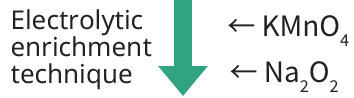
(2) Electrolytic enrichment technique*9,*10
This is a method of enriching tritium and is used for detecting samples with low tritium concentration
(e.g., seawater). This method involves reducing the volume of distilled water samples by electrolysis
and enriching tritium through the isotope effect (water containing protium and deuterium is more easily
electrolyzed than water containing tritium). It is possible to enrich tritium 6-8 times. There are
primarily two methods employed: electrolysis of alkaline water solutions using metal electrodes and
electrolysis using a solid polymer electrolyte (SPE).
In the method using metal electrodes, hydrogen and oxygen are generated together, which can easily form
oxyhydrogen gas (a mixture of hydrogen and oxygen in the 2:1 volume ratio) and therefore requires strict
safety precautions. It is essential to prevent the generated gases from accumulating indoors by
directing them through silicone tubing or similar means to a safe outdoor location for proper
ventilation and exhaust.
Analysis flow
Water
Decompression distillation

Distillate(500 mL)
Electrolytic enrichment
2 weeks (enriched to about 60mL)
Atmospheric pressure distillation
←Emulsion scintillator 50 mL
Distillate(50 mL)
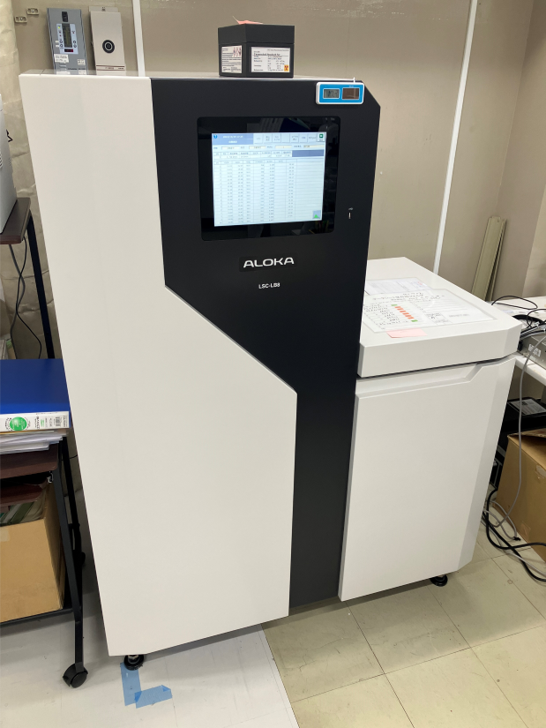
LSC
Organism
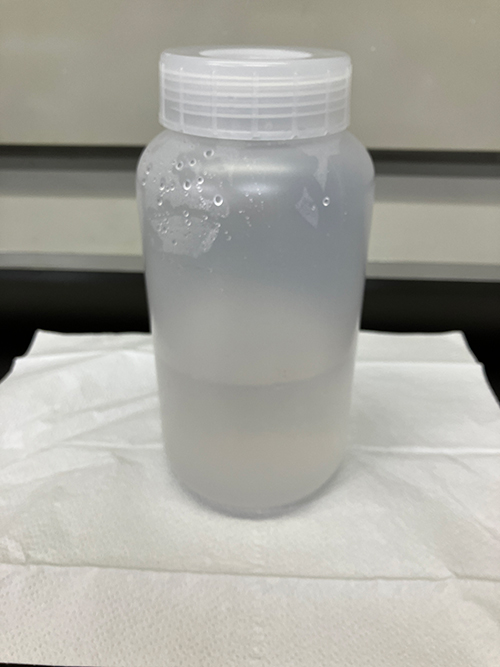
Freeze-drying
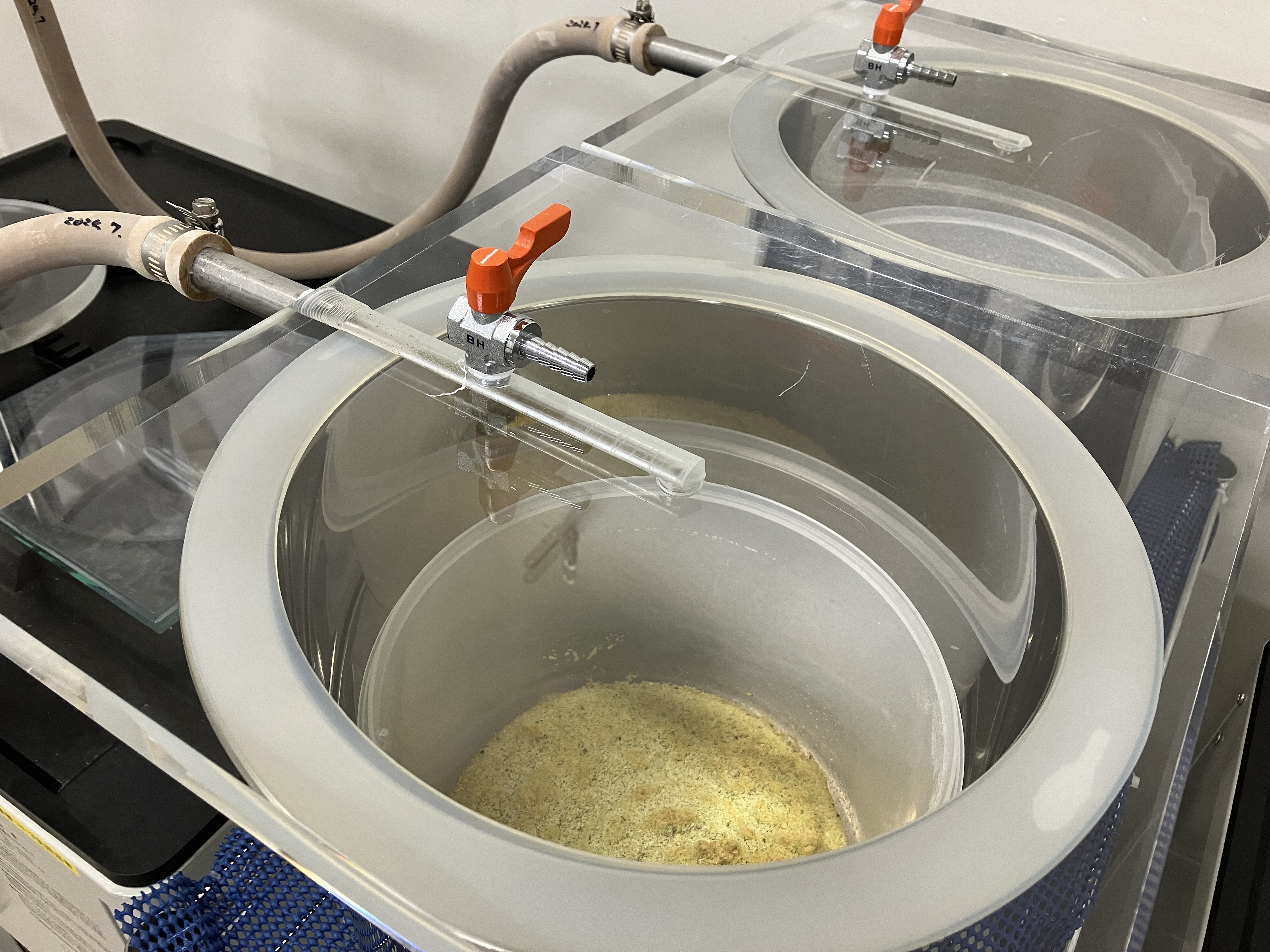
Tissue-free water

Dry matter
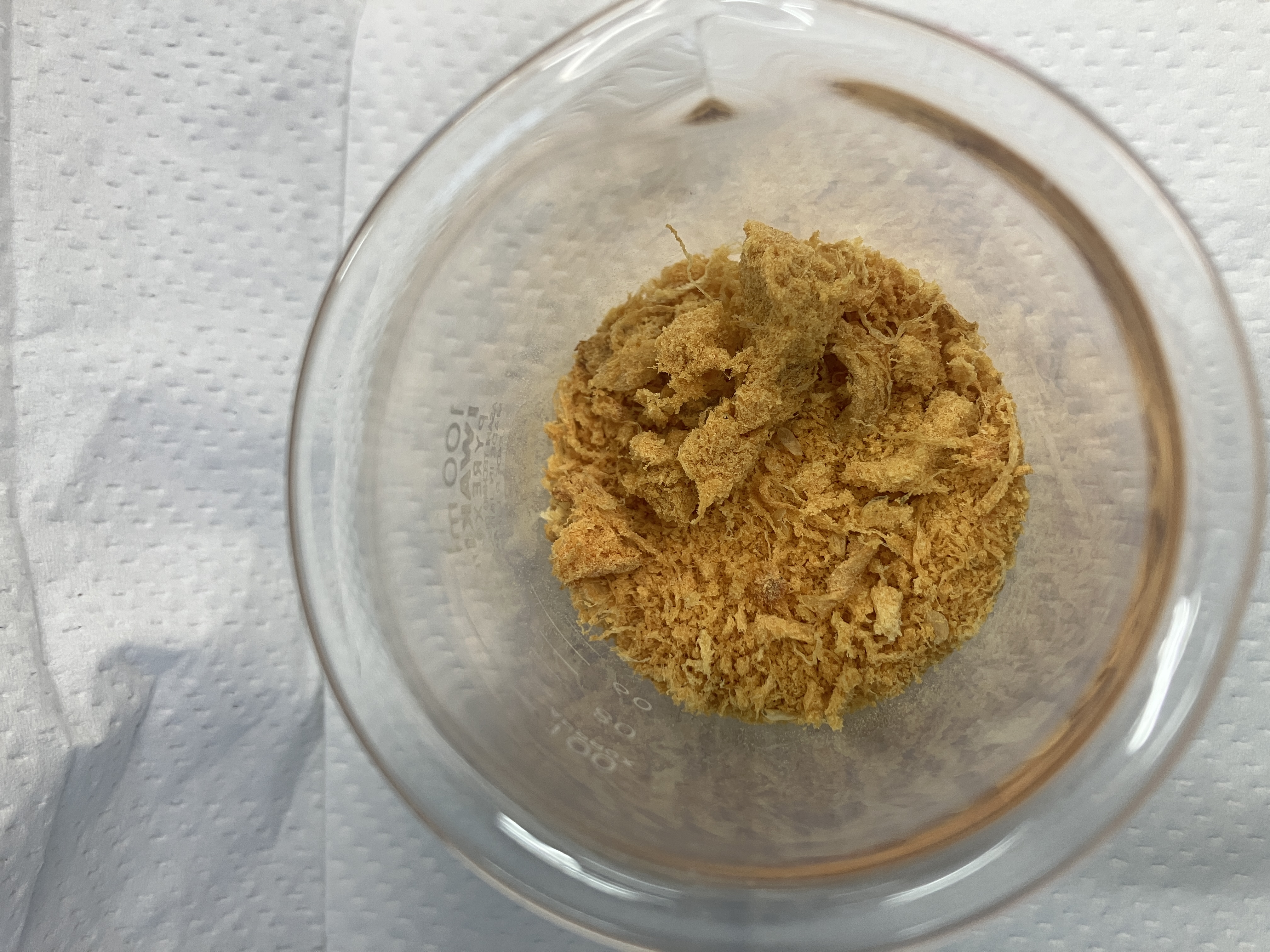
Combustion
Reflux
Distillation
Distillate(50 mL)
←Emulsion scintillator 50 mL
LSC
Topics
Topics1
Beware of luminous watches!*11-*13
Some foreign-made luminous watches use tritium as luminous paint.
There have actually been reports*1 of tritium leaking from clocks contaminating sample water,
so caution
should be exercised.
In one case, an abnormally high tritium concentration in an analytical sample was investigated and found
to be caused by a luxury wristwatch worn by pretreatment staff.
There were also reports that tritium was released from the plywood (protector mounting board) inside the station’s safety equipment storage box.
People should be reminded that bringing such items to the tritium analysis area is strictly prohibited. If
abnormal values are detected, the possibility of laboratory or sampling site contamination should be
considered.
Topics2
About static electricity*14
In liquid scintillation measurement, pseudo-counting due to static electricity may occur. In particular, Teflon vials are easily charged, and the probability of this occurring increases in liquid scintillation counters where the vials move on a turntable. There are two ways to prevent this: by spraying the measurement vial with an antistatic spray before starting the measurement or by using the static electricity elimination mechanism of the ion shower built into the liquid scintillation counter. Even with these measures in place, static electricity can still occur. It's particularly likely to happen immediately after replacing a vial in the analyzer, so it might be best to discard the initial few data points.
Topics3
Refining methods other than distillation
There are other ways to remove impurities from water samples besides distillation. This method involves
purifying the water by passing the sample water through a column containing a mixture of anion exchange
resin and cation exchange resin and adsorbing the impurities onto the resin. Commercially available
pre-packed columns are designed for small-volume samples, and if the sample volume is about 10 mL, the
column eluate can be directly measured by liquid scintillation counting.
Compared to the distillation method, the small size of the laboratory bench required for analysis and the
fact that no glassware is needed make this method an effective method when a large amount of sample needs
to be purified in a single step. In addition, even in laboratories without electrical equipment, this
column can be used for tritium analysis pretreatment, as it does not require electricity. Purification can
be achieved by packing a column with a 1:1 mixture of cation and anion exchange resin. This method is
suitable for low-salinity samples such as tap water, but for high-salinity samples such as seawater, the
residual ions may not be removed completely, or the flow rate may decrease or even cease, so some
modifications may be necessary, such as increasing the amount of resin or dilution. Similar to
distillation, it is advisable to check the purification by conductivity measurement before mixing with a
scintillator.
Topics4
Tips to speed up freeze-drying*15
Vacuum freeze-drying is an essential process for OBT and TFWT analysis. However,
this process can be quite time-consuming. Did you know that there’s a cost-effective way to speed up this
process?
Simply by reducing the sample size, you can significantly increase the surface area, leading to faster
processing times.
You might be surprised to learn this, but it's true!
When we compared vacuum freeze-drying 1 kg of marine organism in a sheet form versus five divided parts,
the sheet form took 9 days to process, while the divided sample was completed in just 5 days, nearly twice
as fast.
If you need your analysis results sooner, consider dividing your samples into smaller pieces before
freeze-drying.
Related radioactivity measurement series

References
-
*1
Evaluated Nuclear Structure Data File. https://www.nndc.bnl.gov/ensdf/, (cited 2024-10-1)
-
*2
J. S. Coursey, D. J. Schwab, J. J. Tsai, R. A. Dragose. Atomic Weights and Isotopic Compositions with Relative Atomic Masses, NIST Physical Measurement Laboratory(Last update: January 2015). https://www.nist.gov/pml/atomic-weights-and-isotopic-compositions-relative-atomic-masses, (cited 2024-10-1)
-
*3
D. G. Jacobs. Sources of Tritium and Its Behavior Upon Release to the environment. Oak Ridge National Lab. (ORNL), Oak Ridge, TN (United States), 1968, TID-24636.
-
*4
Tatsuhiko Uda, Masahiro Tanaka. Tritium Distribution in the Environment and Transfer Model of Tritium Released from Nuclear Facilities: 2. Recent Status and Distribution of Environmental Tritium 2.1 History of Atmospheric Tritium Concentrations and Measurement of Tritiated Water Vapor, Hydrogen and Methane Gases.
-
*5
Hideki Kakiuchi, Tritium in the environment and its evaluation methods. Journal of the Atomic Energy Society of Japan. 2018, vol. 60, no. 9, p. 537-541.
-
*6
UNSCEAR(United Nations Scientific Committee on the Effects of Atomic Radiation). Sources and Effects of Ionizing Radiation, UNSCEAR 2000 Report to the General Assembly, with Scientific Annexes, Volume I: Sources, Annex A: Dose assessment methodologies. 2000.
-
*7
Website of Ministry of Economy, Trade and Industry(https://www.meti.go.jp/earthquake/nuclear/hairo_osensui/alps.html)(Available on October 1, 2024)
-
*8
Prime Minister's Official Residence, Policy Council. Ministerial Conference on Decommissioning, Contaminated Water and Processed Water: Basic Policy on the Disposal of Water from Advanced Liquid Processing System at Tokyo Electric Power Company's Fukushima Daiichi Nuclear Power Station. Ministerial Conference on Decommissioning, Contaminated Water, and Processed Water (5th Meeting). https://www.meti.go.jp/earthquake/nuclear/hairo_osensui/alps_policy.pdf , (Referred to on October 1, 2024)
-
*9
Hideki Kakiuchi. Tritium Separation and Enrichment Technology: 4. Electrolytic Enrichment Technique of Tritium in Water for Environmental Analysis
-
*10
“UNSCEAR. Sources, Effects and Risks of Ionizing Radiation, UNSCEAR 2016 Report to the General Assembly, with
Scientific Annexes, Annex C : Biological effects of selected internal emitters—Tritium. 2016.” -
*11
Yoshihiko Murakami, Application of Radioisotope for Radio-luminous Watch and Clock Industry in Japan. Health Physics.
-
*12
Hideki Tokuyama, Akemi Yoshida. Transfer of Tritiated Water Vapor from a Radio-luminous Watch to Water.
-
*13
Toshinobu Kasuga, Tatsuo Shimotori, and Tomohiro Tsuchida. Contamination of Tritium from plywoods in the monitoring station. Annual Report of Niigata Radiation Monitoring Center.
-
*14
Kaneaki Sato, Yoko Ono, Wataru Nitta, Takeshi Maeyama, Keisuke Isogai and Hideo Higuchi. Reliability of the Analytical Result of Tritium with Liquid Scintillation Counting and Examination of Different Counting Vials.
-
*15
H. Kuwata. et al. Rapid Tritium Analysis for Marine Products in the Coastal Area of Fukushima. Radiation Environment and Medicine. 2020, vol 9, no. 1, p. 28-34.